Help Pets Stay Calm During Vacuuming: A Gentle Plan
Helping Pets Stay Calm Around the Vacuum
Vacuum cleaners can trigger fear in pets because of loud noise, sudden movement, unfamiliar scent, and past negative experiences. The good news: with a few simple environmental tweaks and a step-by-step plan, most dogs and cats can learn to tolerate vacuuming—and many can relax through it—without forcing, chasing, or overwhelming them. For more guidance, see Fearful dogs | Cornell University College of Veterinary Medicine.
Why vacuums feel threatening to pets
From a pet’s perspective, a vacuum isn’t “just a household tool.” It can look, sound, and even smell like trouble—especially to animals that are naturally cautious or sound-sensitive. For further reading, see Adopting an under-socialized dog – Humane Colorado.
- Noise sensitivity: vacuums can be uncomfortably loud, with shifting pitch and vibration that some dogs (and many cats) find physically stressful.
- Movement pattern: a large object that approaches, retreats, and pivots quickly can resemble a predator or a “chasing” threat.
- Airflow and debris: strong suction and blowing dust can overwhelm pets with sensitive noses, and the smell of stirred-up debris may add to unease.
- Learned fear: one startling incident—tail brushed, cord snapped, sudden start—can create a lasting negative association.
- Body-language clues: whale eye, crouching, hiding, pacing, trembling, barking, swatting, bolting, or aggression are signs to slow down and increase distance.
If your pet is showing intense fear or escalating behavior, it can help to review reputable animal behavior guidance such as the American Veterinary Medical Association (AVMA) animal behavior resources.
Set up a calm zone before training begins
Before you practice any “vacuum training,” set your pet up with a predictable retreat. This isn’t avoidance—it’s a safety valve that prevents panic and stops fear from getting worse.
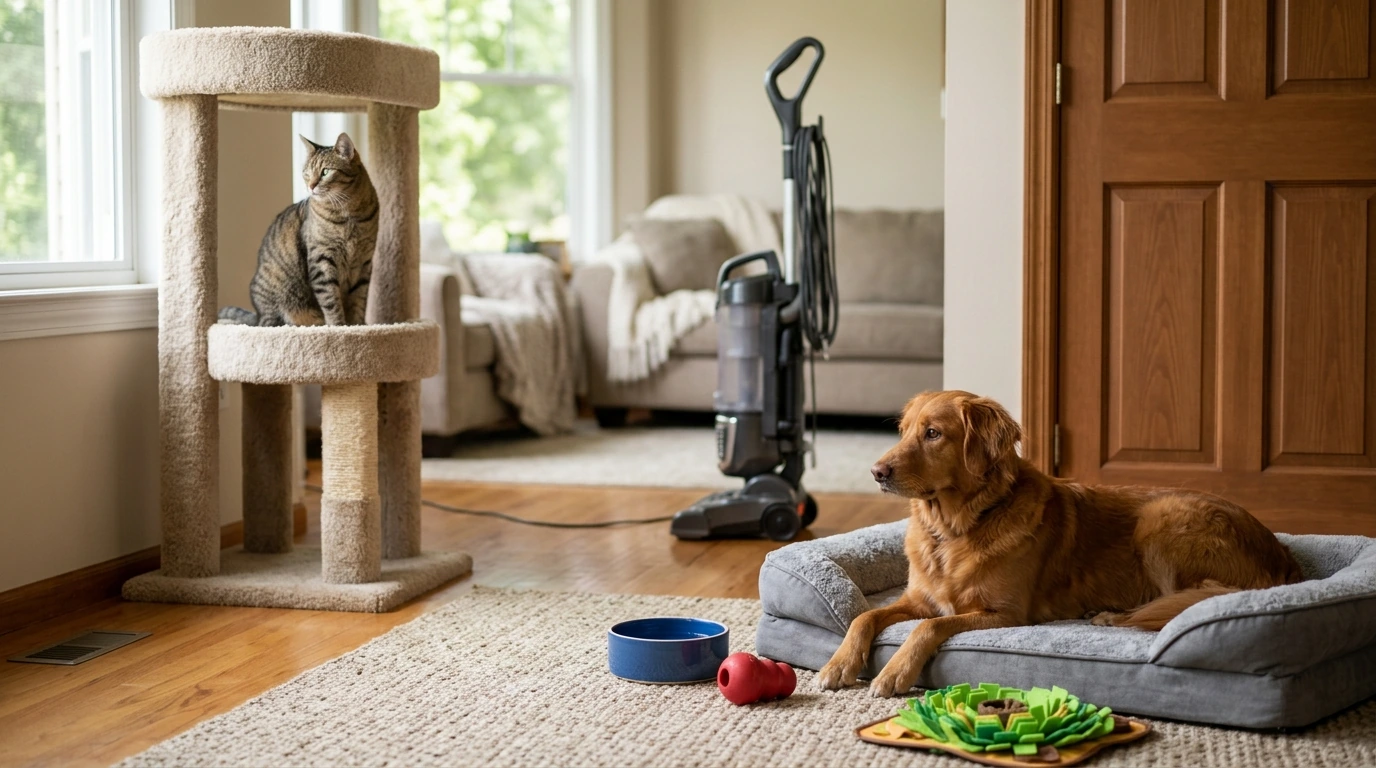
- Create a predictable safe spot: a covered crate, a back bedroom, or a tall cat tree area stocked with water, bedding, and a long-lasting chew or food puzzle.
- Use sound buffering: close doors, add a draft blocker, run a fan/white noise, or play one consistent music track to soften the vacuum’s sudden spikes.
- Adjust cleaning timing: choose a time after exercise and bathroom breaks, when your pet is more likely to settle.
- Increase distance: start vacuuming farthest from the calm zone; avoid cornering a pet or vacuuming straight toward them.
- Manage visual stressors: store the vacuum out of sight when not training, and reduce cord clutter that can startle.
A step-by-step plan: from “vacuum off” to normal cleaning
This approach uses gradual exposure paired with rewards. The goal is not to “toughen up” a pet; it’s to teach them the vacuum predicts good things and that they always have a safe option.
Stage 1: Vacuum is off
Place the vacuum in the room (powered off). Feed high-value treats at a comfortable distance. End the session while your pet is still able to eat and remain curious—before they feel trapped or overwhelmed.
Stage 2: Movement with no sound
Roll the vacuum a few inches, then treat. Keep sessions very short (about 1–3 minutes) and repeat daily. If your pet tenses, increase distance and make the movement smaller and slower.
Stage 3: Sound at low intensity
Turn the vacuum on in another room for 1–2 seconds, treat immediately, then turn it off. Repeat a few times, then stop. Over several sessions, gradually increase duration while keeping your pet under threshold (able to take treats and recover quickly).
Stage 4: Sound plus distance (managed exposure)
Stage 5: Real-life cleaning
Progress rule
Troubleshooting vacuum stress: what to change first
| If you notice… | Likely cause | Try this adjustment |
|---|---|---|
| Hiding, trembling, refusing treats | Intensity is too high | Increase distance, shorten session, return to vacuum-off pairing |
| Barking/lunging at the vacuum | Barrier frustration or perceived threat | Use a gate for safety, reward looking away, move vacuum in slower predictable lines |
| Cat swats or stalks the vacuum | Overarousal or prey-like tracking | Provide a toy/food puzzle in another room; block access during cleaning |
| Panic when vacuum starts | Startle response | Begin with brief “on” in another room; add white noise and pre-start cue + treat |
| Stress only in certain rooms | Association with a past scare | Rebuild comfort in that room with vacuum off; use extra distance and higher-value rewards |
Handling and safety: what to avoid during vacuum training
Helpful supports that make progress easier
If you’d like a ready-to-follow plan, Helping Pets Handle Vacuum Stress offers structured steps and practical routines to support calm behavior around cleaning tools.
For households also working on foundational manners and daily structure (especially with young dogs), the New Puppy Training Starter Guide can help build skills like settling on a mat, following cues, and relaxing during busy home activities.
When to get extra help
FAQ
How long does it take for a pet to get used to a vacuum?
It varies from a few days to several weeks depending on your pet’s sensitivity and how consistently you practice. Good progress looks like your pet eating treats, showing a looser body, and choosing the safe zone (or calmly staying nearby) without escalating fear.
Should the vacuum be turned on during early training sessions?
Start with the vacuum off and pair its presence (and tiny movements) with rewards. Introduce sound later with very brief “on” exposures at a distance, and increase only one variable at a time so your pet stays comfortable.
What if my dog barks and charges the vacuum every time?
Prioritize safety and prevent rehearsal by using a gate or separate room during cleaning. Reward calm alternatives like looking away or going to a mat, move the vacuum in slower predictable lines, and seek professional help if the intensity is high or escalating.










Leave a comment